



A patient with uncontrolled diabetes kept returning to a Community Health Center clinic on California’s Central Coast with worsening blood sugar levels. His doctor prescribed insulin. The care team reviewed the treatment plan. But nothing seemed to improve.
It would have been easy to label the patient “non-compliant” — a term commonly used when patients do not follow treatment recommendations.
But during the visit, the physician supervising PA student Peter-John Van Beurden dug deeper.
The patient lived in a rented room without a refrigerator. He had nowhere to properly store his insulin. He also lacked access to fresh food and relied largely on packaged, processed meals.
“Of course, these conditions made it impossible for the patient to control their diabetes, even while wanting to,” Van Beurden said. “I always think about that patient when the word ‘non-compliance’ comes up. Especially with our Community Health Center (CHC) patients, there might be barriers in the way that need creative brainstorming to overcome.”
For Van Beurden, a second-year physician assistant student at A.T. Still University (ATSU), the encounter reinforced one of the central lessons of his clinical training: medicine cannot be separated from the realities of patients’ lives.
That philosophy — training providers to meet patients where they are inside the communities they will eventually serve — has shaped ATSU’s partnership with the National Association of Community Health Centers (NACHC) for two decades and continues to guide how the university trains physician assistants, physicians, and dentists to serve populations with limited access to health care.
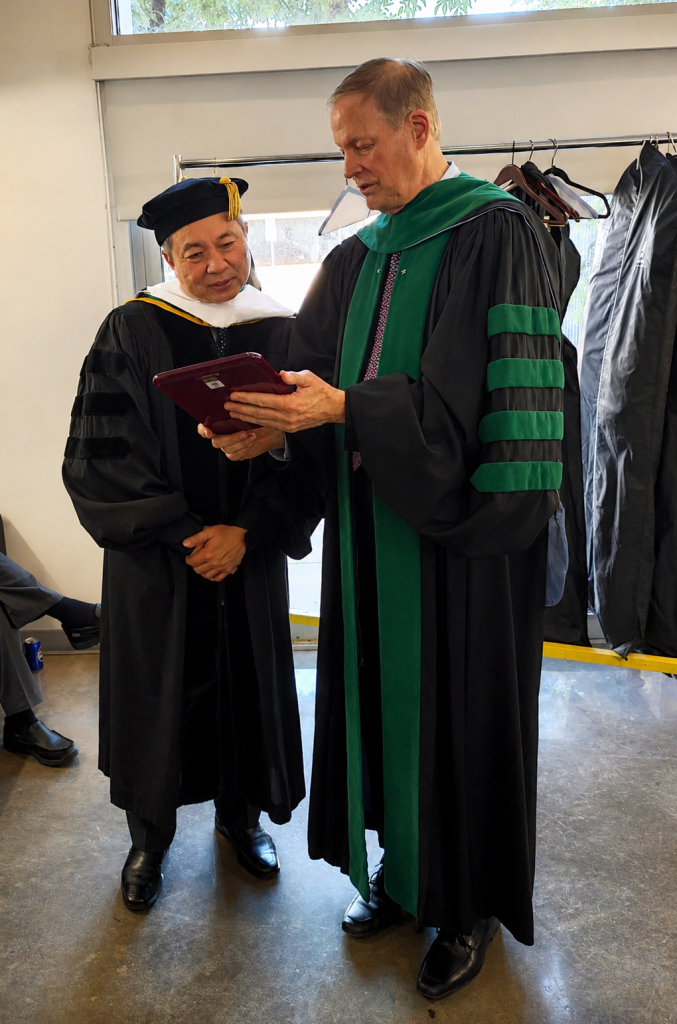
Addressing graduates at ATSU’s School of Osteopathic Medicine in Arizona (SOMA) commencement ceremony on May 22, Dr. Kyu Rhee reflected on the origins of the partnership between ATSU and NACHC, where he serves as president and CEO.
“The idea was both simple and radical,” Rhee told graduates. “If you train physicians inside Community Health Centers — in the actual communities where patients live, not just in academic medical centers — those physicians will understand the context of their patients’ lives. They’ll know what it means to practice in a place where resources are limited but the quality of care is not. And they’ll be more likely to stay.”
Today, that philosophy drives ATSU’s Central Coast Physician Assistant Program, developed in partnership with NACHC to train future primary care providers for careers serving medically underserved patients in Community Health Centers.
“We’re working to produce providers that mirror the populations that we’re preparing them to serve,” said Dr. Eric L. Sauers, dean of the College for Healthy Communities at ATSU’s Santa Maria campus.
Cultivating the Primary Care Workforce of Tomorrow
Focused on expanding the primary care workforce, NACHC came to ATSU looking to partner on clinical training for PAs at Community Health Centers.
“NACHC understands we’re not going to meet the primary care workforce needs in the future through physicians alone,” Dr. Sauers said. “Physician assistants are a huge part of the future primary care workforce.”
ATSU’s PA students are placed in CHCs across the country to complete rotations in family medicine, pediatrics, behavioral health, women’s health, and other specialties — all while staying embedded in the CHC environment.
“We try to put a student in a community rather than just a disjointed clinic-to-clinic experience,” said Dr. Jennifer Harrington, department chair and program director for the Central Coast Physician Assistant Program. “I think that CHC immersion is a big part of why a lot of the students choose to return to those CHCs and work there if offered a position.”
For ATSU, that pipeline is inseparable from its broader mission.
“When I think about ATSU’s mission, one of the most important things is that we are focused on medically underserved patient populations — and we demonstrate that through our curriculum, through the work that we do, and through the people we engage,” said Dr. Kim Perry, ATSU’s chief partnership officer. “The reason our partners are NACHC and Community Health centers across the country is because we know they see 70% of the medically underserved. We want our students caring for that patient population.”
Clinical Training Integrated in High-Need Communities
ATSU faculty prepare students for the CHC environment well before their clinical rotations begin. Students are introduced to whole-person care, including non-clinical factors and complex patient challenges such as housing instability, insurance gaps, and transportation barriers.
For one internal medicine rotation in Santa Maria, Van Beurden worked alongside a physician who saw 25 to 35 patients daily — many of whom he had treated for years.
“He knew about their lives and what they’d gone through and had seen them throughout their health journeys,” Van Beurden said. “Getting the repetition and the volume of patients and getting to be on the ground with the doctor like that was really valuable.”
Echoing this, Rhee told SOMA graduates in May: “Behind every chart is a human being with a life that extends far beyond the exam room. That is what you have been trained to do.”
Recruiting Mission-Focused Providers
Dr. Harrington’s doctoral research examined what predicts long-term service in medically underserved settings — and what she found shaped how ATSU recruits and trains students.
“One factor that attracts many students is some kind of experience before going to PA school — whether it’s serving or experiencing being an underserved patient,” she said.
ATSU focuses on recruiting students from socioeconomically disadvantaged backgrounds, health professional shortage areas, and CHC-served communities. Partner health centers can also endorse prospective students directly.
“If the students have relationships with a Community Health Center and they believe that you’ve got the right heart and talent to become a future physician assistant, they can endorse you,” Dr. Sauers said.
“Community Health Centers tell us, ‘Your students just get it,'” Dr. Perry said. “It has to do with our targeted curriculum — and the fact that many of these students are from CHC communities. They understand, they get the mission.”
Becoming ‘Pillars of the Community’
Van Beurden recalled a conversation with a medical resident who rotated at one of the CHCs where ATSU students train. What stayed with her was watching providers who had taken care of families’ health throughout their lives.
“She said she won’t forget how the providers were like the pillars of their community,” Van Beurden said. “And how rare that is nowadays.”
Rhee echoed this in his May commencement address, calling primary care “the most complete, most demanding, and most human expression of what medicine is supposed to be.”
“It is a relationship — sustained over time, built on trust, oriented toward the whole person,” he said.
For students weighing primary care or community health, Van Beurden’s advice is simple: go spend time inside a CHC. Shadow a provider. Follow a medical assistant for a day.
“I think they’ll be surprised and refreshed to see that that kind of medicine still exists,” he said.